
Pro-Israel media watchdog HonestReporting’s attack on press freedom is making things more difficult.
By Wendy Kaur
Shenaz Kermalli always knew CBC News upheld a slant when it came to covering Israel-Palestine. “I could feel it when I was there and I wasn’t even covering these issues on the desk,” she says. Kermalli has done two stints with Canada’s largest legacy media corporation—once casually from 2000 to 2003, and then again from 2012 to 2014. “It was through other events that were taking place in the Middle East. They seemed to approach things in a very detached way. I could feel the bias.”
Kermalli recalls an example from 2013 when she was working on the desk for the CBC News website. In the background of the Arab Spring, when pro-democracy protests, uprisings, and armed rebellions in the region swelled in response to widespread government repression and deep-seated corruption, Kermalli says that, “In a lot of cases that just meant I was lifting wire copy.” Lifting wire copy refers to when journalists publish text written by news agencies like Associated Press and Reuters, without doing any original reporting. In one wire story about the Muslim Brotherhood, Kermalli recalls: “The piece described the Muslim Brotherhood in a very narrow way: They referred to it as a terrorist group.”
Kermalli, who has also worked for Al Jazeera English, felt the word “terrorist” was narrow and inaccurate. The organization is said to be the world’s oldest and one of its most influential transnational Sunni Islamist political and social movements. Furthermore, Canada does not classify the Muslim Brotherhood as a terrorist organization. “When you sweep it under the rug as a terrorist organization, you’re erasing the complexity of the movement,” she says. “What’s more is that people on the ground in the region engage with it in different ways—the movement has charitable aspects to it, for instance.”
Kermalli changed the wording to say that the Muslim Brotherhood, at its base, was a political movement. “It was strange how they responded,” she says. “They sent out a note to everyone on the editorial desk saying that nobody should be changing wire copy. They said the only thing we were allowed to change was the headline and the decks—but nothing within the copy itself.”
What surprised Kermalli was that no one approached her about it. “They didn’t come to me directly even though they knew I was the writer—I use that word loosely—but I was the one who put the piece up on the site.” It could have been helpful if they had, she says. “It could have been a conversation where I shared my insights. If they didn’t agree that was fine but at least I would have had the opportunity to explain why I had made the change.”
At the time, Kermalli wasn’t sure if the lack of contextual coverage by CBC News was because of a bias against Arab-Muslim communities in the Middle East, or if it was because they didn’t have the capacity to cover the people on the ground in the best way. “It could have been a general ignorance of the region,” she adds.
A decade later, the CBC’s highly skewed coverage of Israel’s ongoing genocide on Gaza is predictable to Kermalli, but there’s one thing that has stunned the former writer/producer for the BBC. Kermalli—who launched the course, Decolonizing Journalism for the University of Toronto Continuing Studies—is baffled at the extent to which Canadian mainstream media outlets have gone to stifling Palestinian perspectives. “The way they are making it so difficult to accept pitches from journalists who are proposing very strong angles—like how Palestinian Christians were impacted in the early days after October 7—feels very noxious,” she says. “How difficult they are making that process has shocked me.”
Before Oct. 7, 2023, Kermalli says her Middle East-focused pitches—mainly on Gulf countries, although some were centered around the Israel-Palestine conflict—were often accepted. She says, “After October 2023, it was close to impossible to get anything accepted in The Toronto Star or The Globe and Mail.”
One or two op-eds about Israel-Palestine that did make it into The Star only did so because she happened to know people internally who helped her push the stories through. “It was crazy to see how distraught these two staffers were with taking this on. It’s not something they had to take on but they wanted to because they knew it was important,” she says. “But what they had to go through in the process of doing that was a lot. It’s insane what Canadian media is doing to journalists who have taken it upon themselves to change the narrative.”
A systemic issue
Mainstream Canadian media is more passive on Israel-Palestine today than it was 50 years ago, says Samira Mohyeddin, who resigned from her role as producer of CBC Radio on their national daily flagship program, in November 2023. She was pulled into her managing editor’s office about things she had been posting to her social media after October 7.
“For instance, I said Israel bombed the Al-Ahli Hospital and my editor said I had no proof of this,” she says. “I remember saying I have the weight of history and precedence. That was my proof. I didn’t need to be on the ground in Gaza to know what Israel does and has been doing.”
Mohyeddin kept being called back in even for things like retweeting Human Rights Watch posts. The CBC pulled her off more and more stories, assigning her instead to pieces on whales and ducks, for example. “I decided: I can’t be here and this isn’t the type of journalism I want to do during this genocide. I didn’t want to be in a place where my knowledge was going to be a liability for my employer instead of an asset,” she says. “I decided it was time to leave.” Shortly after resigning, Mohyeddin founded and launched her own media company, On the Line Media.
Mohyeddin, who also has a Master’s degree in Middle Eastern history, says that if you look at the CBC’s footage from the 1970s and 1980s, words like apartheid and occupation were used by foreign correspondent Neil Macdonald, to refer to Israel’s control of Palestine. “Now we don’t see those words being used. That’s just disappeared.”
Modern Middle Eastern historian Assal Rad, whose book Don’t Say Palestine: How the Media Manufactured Consent for Genocide was released in September, says one obvious reason references to occupation have vanished is that Western media coverage is rooted in racism and colonialism. “The language has always perpetuated the most basic notion of the civilized Western world juxtaposed with the inherently savage Middle East, without really analyzing the role of the West’s imperialism and imposed violence on the people of that region,” Rad tells Sandy and Nora Talk Politics.
Something that’s changed in modern political history is 9/11 and the “War on Terror,” says Rad. “After the fall of the Soviet Union in 1991, there was the notion that the Western enemy had to be replaced with someone else and that is radical Islam or Islamism. They’ve become the new justification for these endless wars.”
Media outlets are mimicking their governments. “That’s the ultimate point I make in my book,” she says. “The free media—if it’s really free—isn’t supposed to repeat what the government says. It’s supposed to challenge them and make sure they’re telling the truth.”
Pressure from lobby groups
Canadian and Western media has retrogressed because the Israel lobby has grown. “It’s happening in tandem,” says Kermalli. It started with groups like The Committee for Accuracy in Middle East Reporting and Analysis (CAMERA), an American non-profit media-monitoring and research organization whose mission is to promote “accurate” and “balanced” coverage of Israel and the Middle East, coming on the scene in the early 1980s, Rad points out. The organization challenges what it perceived to be anti-Israeli bias and pressured publications to issue corrections.
“In its wake you have HonestReporting in the 1990s,” says Rad. HonestReporting Canada was established in 2003 and is a right-wing pro-Israel media and lobby group. “These two institutions have been around for a long time and they’re literally there to put pressure on the media. Part of this pressure is not to use words like “apartheid” and “occupation” in relation to Israel.”
Rad doesn’t think it’s a coincidence that “you have these two Zionist entities that exist to perpetuate Israel’s narrative, and they are there, by their own admission, to create what they call ‘fair and balanced’ reporting on Israel, which in reality, is incredibly biased reporting.”
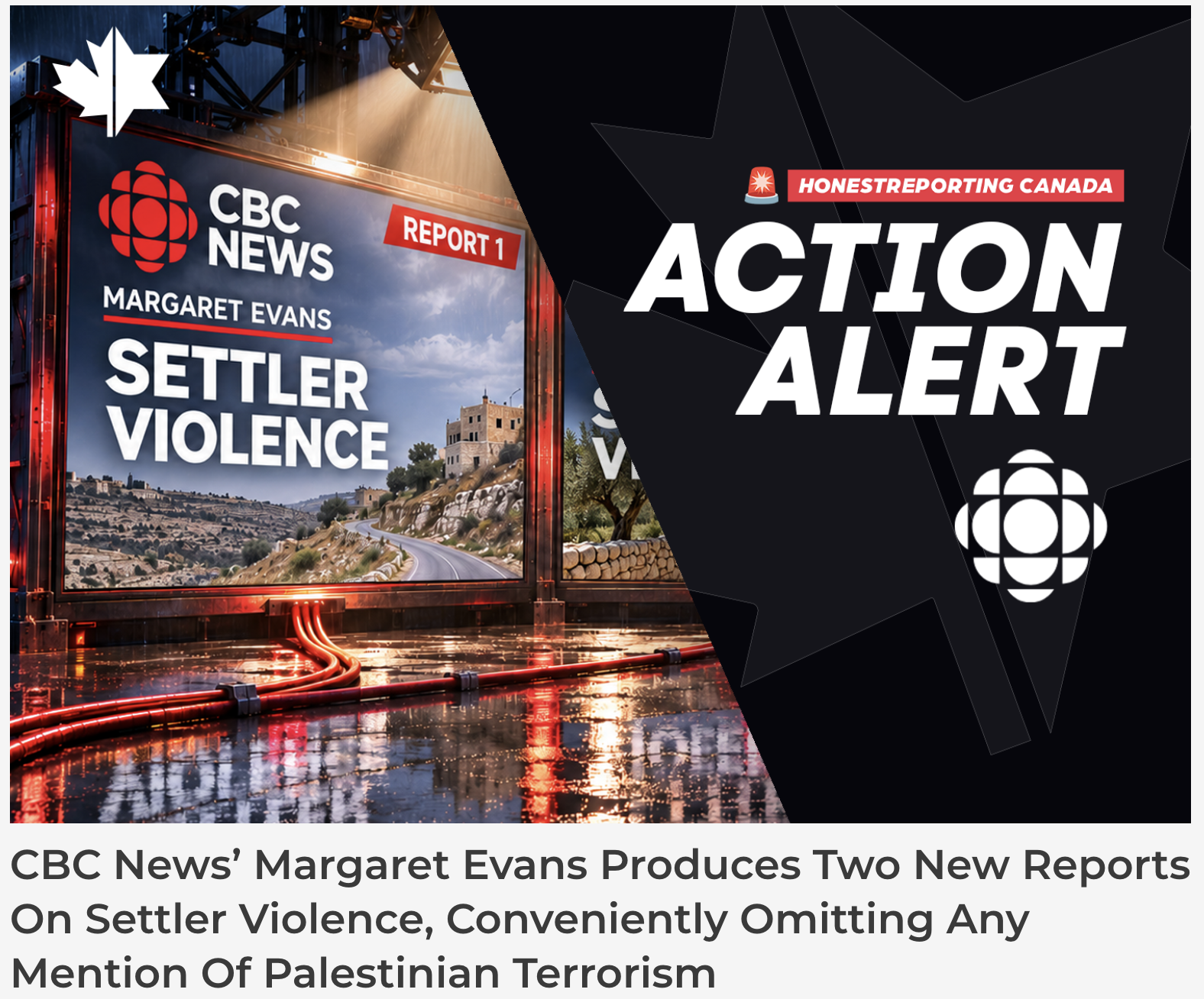 While they purport to call out antisemitic reporting, what’s behind HonestReporting Canada are people who are doxxing reporters, says one editor of an independent Canadian news outlet who asked not to be named. “If you’re a media outlet like the CBC, you live in a state of constant reputational harm. You have to be seen as above the fray, respecting both sides.”
HonestReporting represents a particular attitude and there’s a large Zionist constituency comprised of Jewish and non-Jewish readers, the editor explains. “Subscribers are attached to advertisers, so they feel they need to be careful.”
Robert Walker, an employee of HonestReporting Canada, was charged for spraypainting anti-Palestinian graffiti along with three others, in January 2025.
HonestReporting Canada has a page on their website where they list all the corrections they have forced newsrooms into making. From November 1 to 9, 2026 alone, they declared victory for having details in three stories changed, and issued 14 so-called Action Alerts, where they encouraged their supporters to mobilize to complain about anti-Israel bias in reporting. One of the alerts targets Kermalli and her analysis of the documentary NAZA that was published in The Conversation. “They’re very proud of that. Newsrooms are sensitive to that sort of thing,” says the editor.
They troll the web and jump on things right away, adds Kermalli. “They inundate your inbox and it’s not just a couple of emails saying critical things—it’s hundreds, it’s thousands. They are loud and they have a lot of money behind them. When you read those types of things, it makes you really insecure as an editor.”
They don’t just send them out to editors and writers, either. “They find out who your supporters are and they send them out to their own community. They activate their very large base,” says the editor. “They’ll cherry-pick details and claim anti-Semitism.” Enough subscribers might see this and deem the outlet as untrustworthy. “It’s in their name, right? It’s this sense of ethical diligence that they weaponize. They have a knack for tapping into a blind spot that ordinary citizens have about how the media works.”
The editor says their office has a whole docket list of corrections HonestReporting Canada has demanded of them. “Directly, I’ve never spoken to them. We don’t engage.”
It isn’t surprising that Kermalli has been once again targeted by HonestReporting Canada: she is targeted frequently. “Every time I publish an op-ed anywhere—this is before and after October 7—they cherry-pick things I’ve said and characterize it as pro-Hamas. They see me as siding with Hamas, Hezbollah, the Houthis in Yemen,” she says. “I’ve been named in a National Post op-ed for supposedly indoctrinating journalism students [Kermalli teaches a journalism course at Toronto Metropolitan University] with a narrative that is pro-Hamas. At TMU, I’m on their radar along with two other faculty members who regularly incorporate coverage and the problematic framing of Palestinians into their classes.”
Outlets like the The Globe and Mail and The Toronto Star see it as a risk to their professional reputation if they start taking stories that the lobby has a problem with. “Part of it is our Canadian culture,” says Kermalli. “We don’t like confrontation. So they would rather detach themselves entirely from the conversation than discuss something that is uncomfortable and also something they don’t know a lot about.”
For the anonymous editor’s part, they say that it doesn’t influence who they work with. “We would do this anyway. But it has made us more careful.”
As pro-Palestinian movements galvanize attention, influence, and support—both from the corporate world, some media, and so forth—HonestReporting is clamping down in ways we haven’t seen before, says Kermalli. “It’s getting really obnoxious; a lot of it is AI-generated. They work because of the volume of emails that are hitting people. They make it very easy for people to sign on and express their support.”
Critics within the Jewish diaspora argue that the organization promotes a rigid definition of Jewish identity. “You don’t get a sense of how fractured the Jewish community in Canada is, because for one, the media doesn’t do a good job of covering that either,” says Kermalli.
Opposing media watchdog group Canadians for Justice and Peace in the Middle East (CJPME) regularly calls out Canadian news organizations on anti-Palestinian xenophobia, and advocates for contrasting narratives, demanding more media accountability. “They don’t instill the same fear that HonestReporting does in editors,” says Kermalli. “But we’re in a much better position than we were in 2023 at the beginning of all this.”