
Where is Nidal?
On October 7, 2023, Hamas broke through the wall that kept Gaza from the rest of the world, in an attack that sought to capture hostages to improve its bargaining position with Israel.
Israel held nothing back. In the resulting violence, some 800 Israeli and foreign national civilians were killed.
That morning, a young Palestinian photojournalist ran to the part of the wall that Hamas broke through. He has never been seen since.
For Sandy and Nora Talk Politics, Razan Sharamweh shares the story of Nidal al-Wahidi, and asks if she will ever see her friend again.
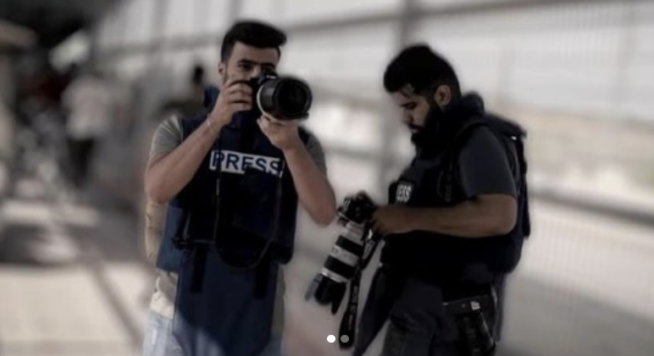
“Answer me. I want to hear your voice before you’re martyred.” For nearly three years, I have wished I had never said those words.
It was supposed to be a joke. It was the kind of dark humour shared between two friends who knew what it meant to be journalists in Gaza, where going out to cover a story could mean risking your life.
Fate Unknown
On October 7, 2023, at around 9:00 a.m., I called Nidal Al-Wahidi, my friend and a prominent young journalist from Gaza, twice. He was thirty-two years old. The first time, he didn’t answer. The second time, he ended the call. So I recorded a voice message and sent it to him: “Answer me. I want to hear your voice before you’re martyred.”
Nidal never replied.
That day, as news of the Hamas-led attack on Israel dominated social media, another story began circulating among my friends: Nidal and another Palestinian journalist, Haytham Abdel Wahed, were missing. The two journalists had gone to the Erez crossing in northern Gaza to report on what was happening there. An Israeli airstrike hit the area shortly after 10:30 a.m. Both journalists disappeared that morning, and neither has been seen ever since.
Since then, international organisations, including Reporters Without Borders, Amnesty International, the International Federation of Journalists and the Committee to Protect Journalists, have called for answers about Nidal’s fate. These agencies and many others knew very well Nidal as a talented journalist-photographer. The thousands of brilliant images that he took build a wonderful chronicle of Gaza and its people: their love of life, misery, steadfastness, the sea they adored and the place they vowed never to leave.
Israeli authorities have repeatedly denied he is in their custody. In February 2026, the Israeli military told Reporters Without Borders that Nidal and Haytham were not being held by the Israeli military and that there was no indication they had been detained by it.
However, in October 2025, Palestinian journalist Shady Abu Sedo was released after a year and a half in Israeli detention, including more than 100 days at Sde Teiman prison. After his release, Abu Sedo said that a fellow detainee told him he had heard Nidal’s name while being held at an Israeli detention centre. He had not seen Nidal himself, leaving only another uncertain clue about what might have happened to him.
Nidal’s whereabouts, along with about 8,000 Palestinians, remain unknown. Rights groups have described his case as an enforced disappearance. Israel continues to deny holding him. Nearly three years after he disappeared, we still do not know where Nidal is, what happened to him, or whether he is alive.
He Chose Gaza
Nine months before the war, in January 2023, Nidal called me from the United States. He was there as part of the International Visitor Leadership Program, organized by the U.S. Department of State.
“Razan, should I go back to Gaza, or should I apply for asylum and stay in the U.S.?” he asked me. I didn’t even have to think. “Nidal, don’t go back,” I said.
I begged him to stay. I was almost angry with him. “Nidal, you’re already in the U.S. You’re from Gaza. You know how difficult it is for us to get an opportunity like this.
Stay there.” His answer stunned me: “Razan, my grandmother is waiting for me. I can’t leave Gaza. I can’t live outside Gaza.”
And he went back.
Nidal knew what returning meant. He had lived through the blockade and repeated wars on Gaza. He had lost relatives and friends. He knew the risks of being a journalist in Gaza. But Gaza was home. When Nidal had the chance to stay away, he chose Gaza.
The Nidal I Knew
But the Nidal I knew was more than the journalist whose name now appears in reports about missing and detained Palestinian journalists.
Nidal laughed a lot. Dark humour was almost his language. Whenever another war started, he would say, “The party has started.” In the middle of a war, he would talk about wanting to go get a farshouha of shawarma, the Gazan word for a shawarma sandwich. He loved food. He was a big teddy bear.
We fought all the time. He would tease me, “Shut up, ya helwa,” “pretty girl” in Arabic, and I would tease him right back: “Shut up, ya naseh,” my way of making fun of him for being a big guy. Nidal was the friend I called when I was afraid. I would call him and say, “You idiot, stay on the phone with me. I’m scared.” And he would stay.
There was also the big softer side of him. Nidal loved a woman from the West Bank. But the reality Palestinians live under meant being in Gaza and loving someone in the West Bank did not necessarily mean you could reach each other, build a life together, or even know when you might see each other again.
I have dealt with Nidal’s absence through denial. Maybe writing about the person he was, not only the missing journalist he became, is another way of confronting that absence.
We Are Not Allowed to Grow Old
Israel stopped my friends’ ages, while mine, somehow, kept running without them. Nidal is not the first of my friends to be disappeared or killed.
Ayman, known as Abu Abdullah, was also from Gaza. When I was nine, he used to help me with my schoolwork and call me al-abeeta, “the silly one,” in Egyptian Arabic. Once, he gave me an Egyptian pound on which he had written, “To the excellent Razan.” He disappeared, and I still do not know whether he is alive.
My childhood friend Mohammed Adnan’s age stopped at 16. During this genocide, my friend Ola Atallah, a journalist, was killed. She never addressed me by my name alone; it was always, “my beloved Razan.” My friend Murad Abu Ghula was also killed. I used to describe our friendship by borrowing former Algerian President Houari Boumediene’s famous saying about Palestine: “We are with Palestine, whether it is the oppressor or the oppressed,” and changing it to: “I am with Murad, whether he is the oppressor or the oppressed.”
Nidal’s friends, his family and I do not bury the living in our hearts; we cultivate his return. My heart is heavy with the dead, but it beats with a fierce, stubborn hope for the missing.
Recent Comments