Palestinian journalist Zahraa Al-Akhrass says the termination has blunted her career.
By Wendy Kaur
In the aftermath of October 7, 2023, Palestinian-Canadian journalist Zahraa Al-Akhrass re-posted a haunting image of a Palestinian family in mourning on her personal Instagram account. Their two-month old dead baby was reportedly found the equivalent of three football fields away from his home after it was hit by an Israeli missile. Al-Akhrass, a former video producer with Global News in Toronto, was on maternity leave at the time.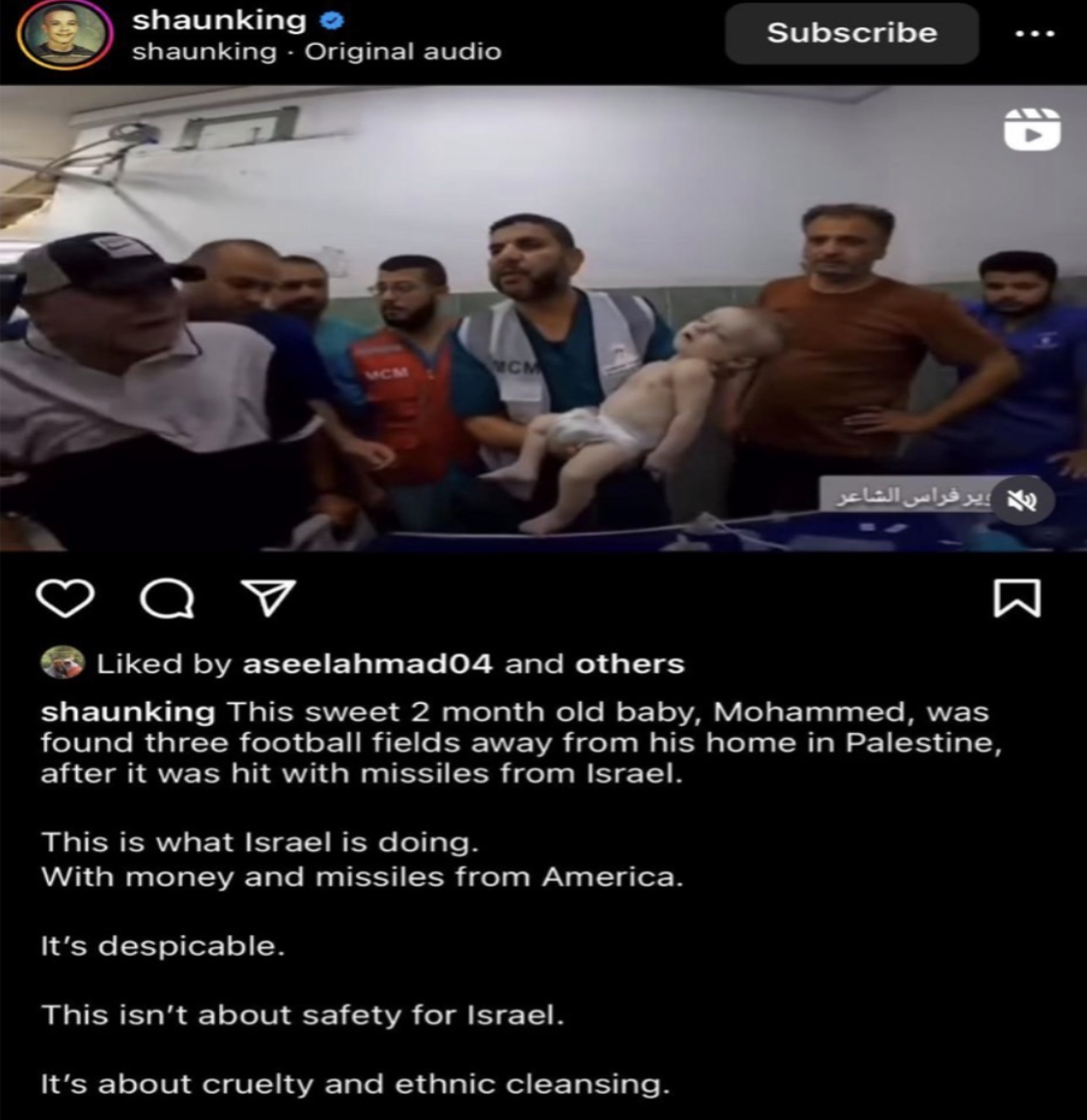
Soon after, Al-Akhrass received an email from her boss. “He said the company had received a formal complaint about my social media activity,” she tells Sandy and Nora Talk Politics, from her home in Doha, Qatar, where she now lives.
She was asked to stop sharing pro-Palestinian posts on her social media and to remove any existing posts that advocated on behalf of the people of Gaza. “They alleged that my posts violated their social media policy but they never explained why or how or which posts were a breach of company policy,” Al-Akhrass explains. “Given that I share a lot of content online I asked him to specify with direct links which content was offensive. They refused.”
She also remembers being told that her re-posts, which often contained hashtags such as #freepalestine, #gazagenocide, and #gazaunderattack, made her seem “unbalanced.”
Al-Akhrass received an email on October 13, 2023 from a Corus Entertainment workplace investigator—the parent company of Global News—who said there were concerns about the posts, and that they wanted to schedule a time to meet the following week. They informed her there would be a representative from the People and Culture department (Human Resources) in attendance and that they would arrange for her to have a union representative present.
Al-Akhrass responded to the workplace investigator with this response:
“Thank you for your email. Here’s an image of what I was looking at when I saw your email. This is one of the thousands of scenes I’ve been watching day and night for a week.” The image was of the family in mourning.
Al-Akhrass says she explained in her response that she was deeply affected by images of Palestinian suffering. She told the investigator she knew people who had died and that she had lost contact with loved ones. She felt an affinity for those suffering because of her own Palestinian heritage. She added that she was reluctant to attend a corporate meeting because she knew they would try to silence her.
She asked for a copy of the complaint. She wanted to know if the company had any requests. Did they want her to remove any and all of the pro-Palestinian comments and posts she had made? Did they want her to stop her online advocacy altogether?
Al-Akhrass had a final 30-minute phone call with Corus Entertainment’s Vice President for Editorial Standards and a senior officer from the People and Culture team who informed her of her termination. “He failed to answer my questions or provide any kind of substantial understanding of either the social media policy or my posts and how they violated the policy,” she says. “It seemed like he didn’t really know what was going on and was just asked to inform me of the decision.
At the end of the call, Al-Akhrass says she was offered a five-figure financial settlement and asked to sign an NDA prohibiting her from publicly speaking about the termination and taking legal action against the company. “I refused to do both,” she says.
Sharing the image of the dead baby was one of the reasons cited in her termination letter for firing her.
By the time the workplace investigator finally got back to her, Al-Akhrass had already been fired. “They asked me never to share any such disturbing images with them without their consent and moved on to see which time would work to schedule a meeting.” She says it seemed strange to her that they wanted to talk after she was already fired. “It was also weird that they fired me without having a discussion about the alleged complaints against me.”
From the Nakba to the genocide
Al-Akhrass’ maternal and paternal grandfathers were born in Palestine. As children aged six and 11, they were forced to flee their country during the 1948 Palestine War, or the Nakba, the ethnic cleansing that violently displaced an estimated 750,000 to 1 million Palestinians. “The village was called Umm Al-Shagaf and about 300 people lived there,” she says.
Today, Umm Al-Shagaf is called Giv’at Nili, and it’s home to 633 Israelis. Founded in 1953 after the forced removal of Palestinian residents, it was created by Labour Zionists to be a collective agricultural centre. Today, it’s known for its wine production and tourism.
Al-Akhrass’ grandparents took refuge in Jordan, the only neighboring country to Palestine that granted Palestinian refugees citizenship, a policy mandated by an agreement with the British. “More than half of the Jordanian population today are actually ancestral Palestinian refugees,” she says.
She was born in Jordan and moved to Canada at age 22 where she studied journalism at Sheridan College.
Al-Akhrass was very proud of her job at Global News. Her team was part of the digital newsrooms and she was responsible for sharing live streams to different platforms. “We provided video content to television, YouTube and social media before the ban,” she says, referring to Meta blocking news content to avoid complying with Canada’s Online News Act, or Bill C-18.
She worked for Global News from February 2020 to October 2023. The end of her employment is forever etched into her mind: “I was nine months postpartum and was suffering from postpartum depression,” she says. “The day I found out that I had been terminated I was going through a health crisis.”
She took to Instagram to announce the dismissal: “I was fired on October 17 for posting about Palestine on my social media,” she said in the video. “This is not about me but about us Palestinians. I feel disappointed that this organization has failed me as a Palestinian, racialized journalist.” The post has gotten over 3 million views.
View this post on Instagram
A grievance in arbitration
Al-Akhrass is pursuing action against Global News for wrongful dismissal—a legal challenge that could set a precedent regarding free speech, employee rights, and the obligations media organizations have towards their staff. “The grievance process has escalated to arbitration,” she says. “There’s a lot of waiting and we’re currently waiting for a hearing date.”
In Canada, unionized employees cannot sue in regular civil courts for dismissal. The grievance and arbitration process is the mandatory legal equivalent, and carries the same binding weight as suing in civil court. The arbitrator’s ruling will be final and legally binding on both the union and the company. “If they rule in my favour, the company is legally forced to comply with the remedy, which is reinstatement or financial compensation. It would be extremely difficult for the company to appeal the decision,” explains Al-Akhrass.
The Unifor grievance letter states her union’s position that Al-Akhrass was fired without just cause, alleging that Global Television did not act “ in a fair, reasonable, and unbiased manner” and did not properly consider her rights.
Sandy and Nora Talk Politics reached out to Unifor about Al-Akhrass’ case and received this statement from Jenny Yuen, a communications representative: “There is an outstanding grievance, and we are working through the procedure with our member. Out of respect for the process, it would be inappropriate to comment further at this time.
After she went public with her story, Al-Akhrass was unable to find alternative employment in Canada’s media sector, so in late 2025, she moved to Doha, where she currently works as an independent journalist with several outlets. “I hoped that working in regional media in the Middle East would be the best option for me after everything that happened,” she says. “I’m a member of the International Press Institute in Vienna which facilitates my attending forums like the Doha Forum and other political and media events in the Middle East.” Al-Akhrass also had another baby this past August.
The termination has made her employment possibilities so much harder. “The moment you Google my name it shows that I was fired from my job,” she says. “This whole thing with Global News has become the defining point of my career.”
Al-Akhrass hopes her experience will help to win justice for every silenced Palestinian voice in the Western media landscape. “This fight is really not for me personally,” she asserts. “If it was, I would have signed the NDA, taken the money, and walked away tens of thousands of dollars richer than I was.”