Sandy and Nora

Episode 401 – How do we actually change the world?

In this episode, Sandy and Nora talk about what it takes to actually change something — how few people, how much work, a bit of courage and a lot of tenacity and you can win any campaign you set out to win.


Image by Kate Bernaski

Ex-CBC Employees: Canadian Mainstream Media is a Barrier to Changing the Narrative on Israel-Palestine

Pro-Israel media watchdog HonestReporting’s attack on press freedom is making things more difficult.

By Wendy Kaur 

Shenaz Kermalli always knew CBC News upheld a slant when it came to covering Israel-Palestine. “I could feel it when I was there and I wasn’t even covering these issues on the desk,” she says. Kermalli has done two stints with Canada’s largest legacy media corporation—once casually from 2000 to 2003, and then again from 2012 to 2014. “It was through other events that were taking place in the Middle East. They seemed to approach things in a very detached way. I could feel the bias.”

Kermalli recalls an example from 2013 when she was working on the desk for the CBC News website. In the background of the Arab Spring, when pro-democracy protests, uprisings, and armed rebellions in the region swelled in response to widespread government repression and deep-seated corruption, Kermalli says that, “In a lot of cases that just meant I was lifting wire copy.”  Lifting wire copy refers to when journalists publish text written by news agencies like Associated Press and Reuters, without doing any original reporting. In one wire story about the Muslim Brotherhood, Kermalli recalls: “The piece described the Muslim Brotherhood in a very narrow way: They referred to it as a terrorist group.”

Kermalli, who has also worked for Al Jazeera English, felt the word “terrorist” was narrow and inaccurate. The organization is said to be the world’s oldest and one of its most influential transnational Sunni Islamist political and social movements. Furthermore, Canada does not classify the Muslim Brotherhood as a terrorist organization. “When you sweep it under the rug as a terrorist organization, you’re erasing the complexity of the movement,” she says. “What’s more is that people on the ground in the region engage with it in different ways—the movement has charitable aspects to it, for instance.”

Kermalli changed the wording to say that the Muslim Brotherhood, at its base, was a political movement. “It was strange how they responded,” she says. “They sent out a note to everyone on the editorial desk saying that nobody should be changing wire copy. They said the only thing we were allowed to change was the headline and the decks—but nothing within the copy itself.”

What surprised Kermalli was that no one approached her about it. “They didn’t come to me directly even though they knew I was the writer—I use that word loosely—but I was the one who put the piece up on the site.” It could have been helpful if they had, she says. “It could have been a conversation where I shared my insights. If they didn’t agree that was fine but at least I would have had the opportunity to explain why I had made the change.”

At the time, Kermalli wasn’t sure if the lack of contextual coverage by CBC News was because of a bias against Arab-Muslim communities in the Middle East, or if it was because they didn’t have the capacity to cover the people on the ground in the best way. “It could have been a general ignorance of the region,” she adds.

A decade later, the CBC’s highly skewed coverage of Israel’s ongoing genocide on Gaza is predictable to Kermalli, but there’s one thing that has stunned the former writer/producer for the BBC. Kermalli—who launched the course, Decolonizing Journalism for the University of Toronto Continuing Studies—is baffled at the extent to which Canadian mainstream media outlets have gone to stifling Palestinian perspectives. “The way they are making it so difficult to accept pitches from journalists who are proposing very strong angles—like how Palestinian Christians were impacted in the early days after October 7—feels very noxious,” she says. “How difficult they are making that process has shocked me.”

Before Oct. 7, 2023, Kermalli says her Middle East-focused pitches—mainly on Gulf countries, although some were centred around the Israel-Palestine conflict—were often accepted. She says, “After October 2023, it was close to impossible to get anything accepted in The Toronto Star or The Globe and Mail.”

One or two op-eds about Israel-Palestine that did make it into The Star only did so because she happened to know people internally who helped her push the stories through. “It was crazy to see how distraught these two staffers were with taking this on. It’s not something they had to take on but they wanted to because they knew it was important,” she says. “But what they had to go through in the process of doing that was a lot. It’s insane what Canadian media is doing to journalists who have taken it upon themselves to change the narrative.”

A systemic issue 

Mainstream Canadian media is more passive on Israel-Palestine today than it was 50 years ago, says Samira Mohyeddin, who resigned from her role as producer of CBC Radio on their national daily flagship program, in November 2023. She was pulled into her managing editor’s office about things she had been posting to her social media after October 7.

“For instance, I said Israel bombed the Al-Ahli Hospital and my editor said I had no proof of this,” she says. “I remember saying I have the weight of history and precedence. That was my proof. I didn’t need to be on the ground in Gaza to know what Israel does and has been doing.”

Mohyeddin kept being called back in even for things like retweeting Human Rights Watch posts. The CBC pulled her off more and more stories, assigning her instead to pieces on whales and ducks, for example. “I decided: I can’t be here and this isn’t the type of journalism I want to do during this genocide. I didn’t want to be in a place where my knowledge was going to be a liability for my employer instead of an asset,” she says. “I decided it was time to leave.” Shortly after resigning, Mohyeddin founded and launched her own media company, On the Line Media.

Mohyeddin, who also has a Master’s degree in Middle Eastern history, says that if you look at the CBC’s footage from the 1970s and 1980s, words like apartheid and occupation were used by foreign correspondent Neil Macdonald, to refer to Israel’s control of Palestine. “Now we don’t see those words being used. That’s just disappeared.”

Modern Middle Eastern historian Assal Rad, whose book Don’t Say Palestine: How the Media Manufactured Consent for Genocide was released in September, says one obvious reason references to occupation have vanished is that Western media coverage is rooted in racism and colonialism. “The language has always perpetuated the most basic notion of the civilized Western world juxtaposed with the inherently savage Middle East, without really analyzing the role of the West’s imperialism and imposed violence on the people of that region,” Rad tells Sandy and Nora Talk Politics.

Something that’s changed in modern political history is 9/11 and the “War on Terror,” says Rad. “After the fall of the Soviet Union in 1991, there was the notion that the Western enemy had to be replaced with someone else and that is radical Islam or Islamism. They’ve become the new justification for these endless wars.”

Media outlets are mimicking their governments. “That’s the ultimate point I make in my book,” she says. “The free media—if it’s really free—isn’t supposed to repeat what the government says. It’s supposed to challenge them and make sure they’re telling the truth.”

Pressure from lobby groups

Canadian and Western media has retrogressed because the Israel lobby has grown. “It’s happening in tandem,” says Kermalli. It started with groups like The Committee for Accuracy in Middle East Reporting and Analysis (CAMERA), an American non-profit media-monitoring and research organization whose mission is to promote “accurate” and “balanced” coverage of Israel and the Middle East, coming on the scene in the early 1980s, Rad points out. The organization challenges what it perceived to be anti-Israeli bias and pressured publications to issue corrections.

“In its wake you have HonestReporting in the 1990s,” says Rad. HonestReporting Canada was established in 2003 and is a right-wing pro-Israel media and lobby group. “These two institutions have been around for a long time and they’re literally there to put pressure on the media. Part of this pressure is not to use words like “apartheid” and “occupation” in relation to Israel.”

Rad doesn’t think it’s a coincidence that “you have these two Zionist entities that exist to perpetuate Israel’s narrative, and they are there, by their own admission, to create what they call ‘fair and balanced’ reporting on Israel, which in reality, is incredibly biased reporting.”
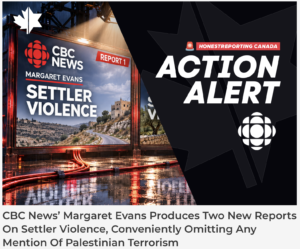
While they purport to call out antisemitic reporting, what’s behind HonestReporting Canada are people who are doxxing reporters, says one editor of an independent Canadian news outlet who asked not to be named. “If you’re a media outlet like the CBC, you live in a state of constant reputational harm. You have to be seen as above the fray, respecting both sides.”

HonestReporting represents a particular attitude and there’s a large Zionist constituency comprised of Jewish and non-Jewish readers, the editor explains. “Subscribers are attached to advertisers, so they feel they need to be careful.”

Robert Walker, an employee of HonestReporting Canada, was charged for spraypainting anti-Palestinian graffiti along with three others, in January 2025.

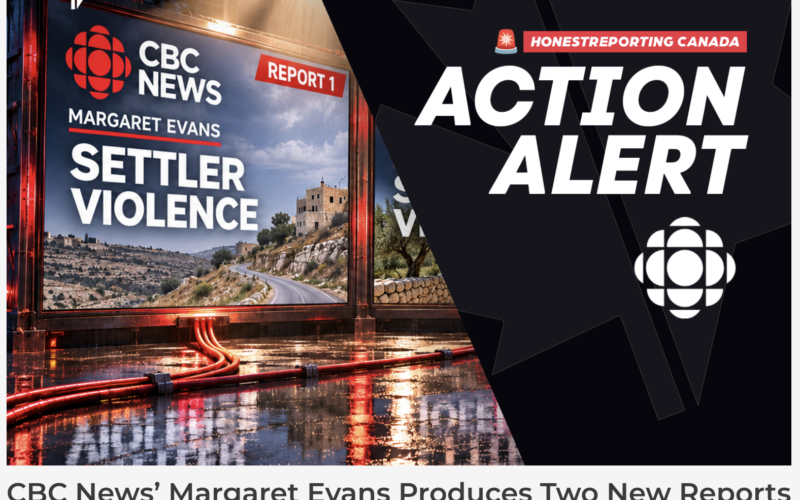
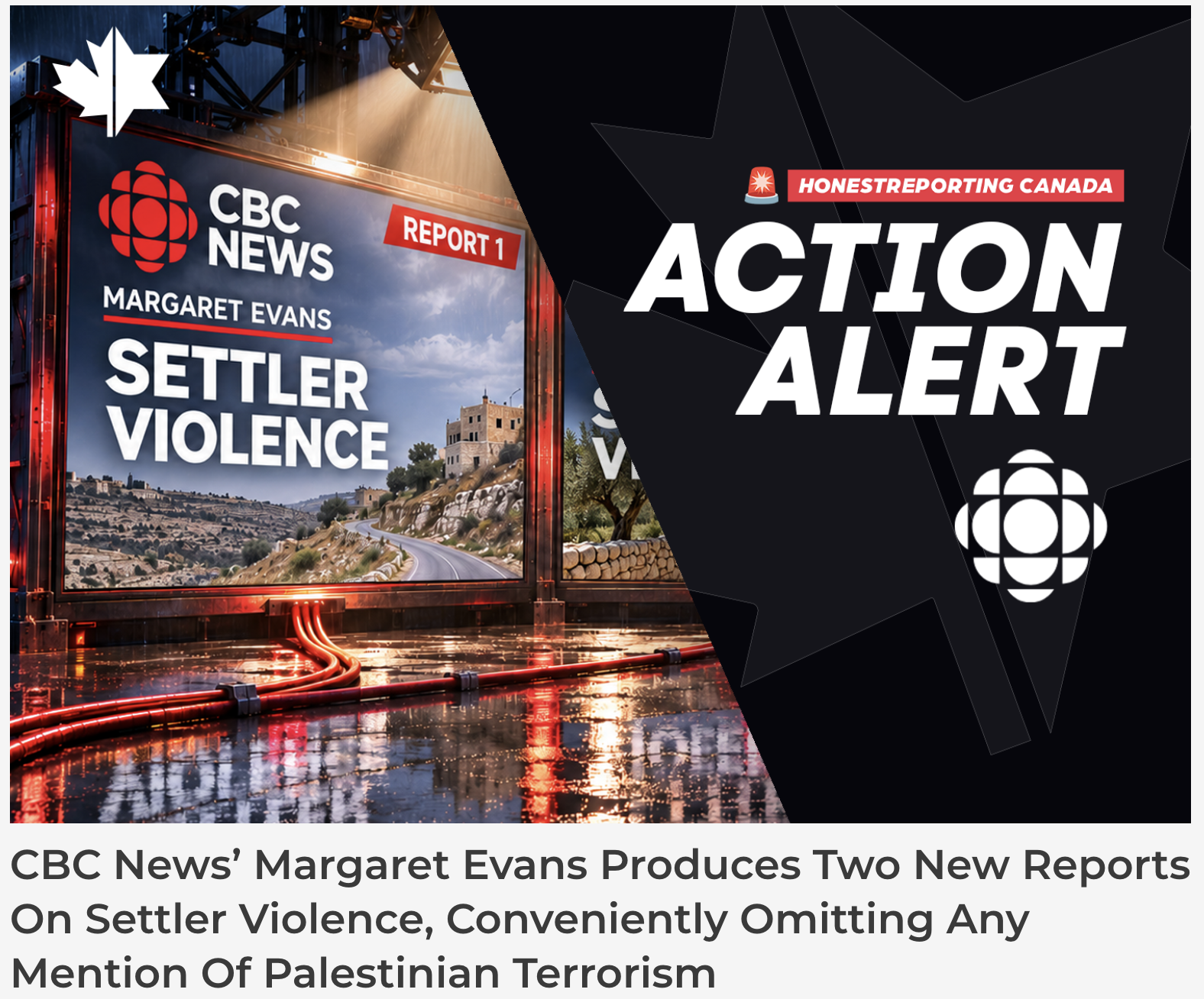
HonestReporting Canada has a page on their website where they list all the corrections they have forced newsrooms into making. From November 1 to 9, 2026 alone, they declared victory for having details in three stories changed, and issued 14 so-called Action Alerts, where they encouraged their supporters to mobilize to complain about anti-Israel bias in reporting. One of the alerts targets Kermalli and her analysis of the documentary NAZA that was published in The Conversation. “They’re very proud of that. Newsrooms are sensitive to that sort of thing,” says the editor.

They troll the web and jump on things right away, adds Kermalli. “They inundate your inbox and it’s not just a couple of emails saying critical things—it’s hundreds, it’s thousands. They are loud and they have a lot of money behind them. When you read those types of things, it makes you really insecure as an editor.”

They don’t just send them out to editors and writers, either. “They find out who your supporters are and they send them out to their own community. They activate their very large base,” says the editor. “They’ll cherry-pick details and claim anti-Semitism.” Enough subscribers might see this and deem the outlet as untrustworthy. “It’s in their name, right? It’s this sense of ethical diligence that they weaponize. They have a knack for tapping into a blind spot that ordinary citizens have about how the media works.”

The editor says their office has a whole docket list of corrections HonestReporting Canada has demanded of them. “Directly, I’ve never spoken to them. We don’t engage.”

It isn’t surprising that Kermalli has been once again targeted by HonestReporting Canada: she is targeted frequently. “Every time I publish an op-ed anywhere—this is before and after October 7—they cherry-pick things I’ve said and characterize it as pro-Hamas. They see me as siding with Hamas, Hezbollah, the Houthis in Yemen,” she says. “I’ve been named in a National Post op-ed for supposedly indoctrinating journalism students [Kermalli teaches a journalism course at Toronto Metropolitan University] with a narrative that is pro-Hamas. At TMU, I’m on their radar along with two other faculty members who regularly incorporate coverage and the problematic framing of Palestinians into their classes.”

Outlets like the The Globe and Mail and The Toronto Star see it as a risk to their professional reputation if they start taking stories that the lobby has a problem with. “Part of it is our Canadian culture,” says Kermalli. “We don’t like confrontation. So they would rather detach themselves entirely from the conversation than discuss something that is uncomfortable and also something they don’t know a lot about.”

For the anonymous editor’s part, they say that it doesn’t influence who they work with. “We would do this anyway. But it has made us more careful.”

As pro-Palestinian movements galvanize attention, influence, and support—both from the corporate world, some media, and so forth—HonestReporting is clamping down in ways we haven’t seen before, says Kermalli. “It’s getting really obnoxious; a lot of it is AI-generated. They work because of the volume of emails that are hitting people. They make it very easy for people to sign on and express their support.”

Critics within the Jewish diaspora argue that the organization promotes a rigid definition of Jewish identity. “You don’t get a sense of how fractured the Jewish community in Canada is, because for one, the media doesn’t do a good job of covering that either,” says Kermalli.

Opposing media watchdog group Canadians for Justice and Peace in the Middle East (CJPME) regularly calls out Canadian news organizations on anti-Palestinian xenophobia, and advocates for contrasting narratives, demanding more media accountability. “They don’t instill the same fear that HonestReporting does in editors,” says Kermalli. “But we’re in a much better position than we were in 2023 at the beginning of all this.”
Episode 400 – Corporate Budget Buffet

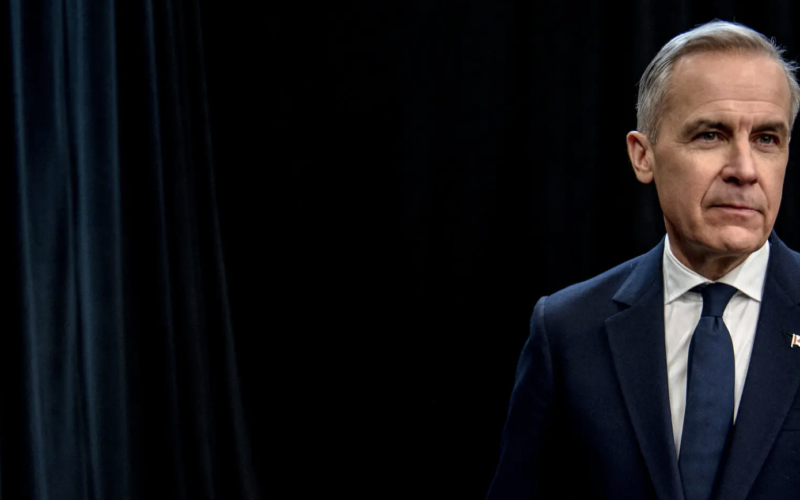
In this episode, Sandy and Nora talk about Mark Carney’s second budget, and how it’s embarrassingly bad.

Former Global News Producer on Being Fired For Her Palestinian Advocacy

Palestinian journalist Zahraa Al-Akhrass says the termination has blunted her career. 

By Wendy Kaur 

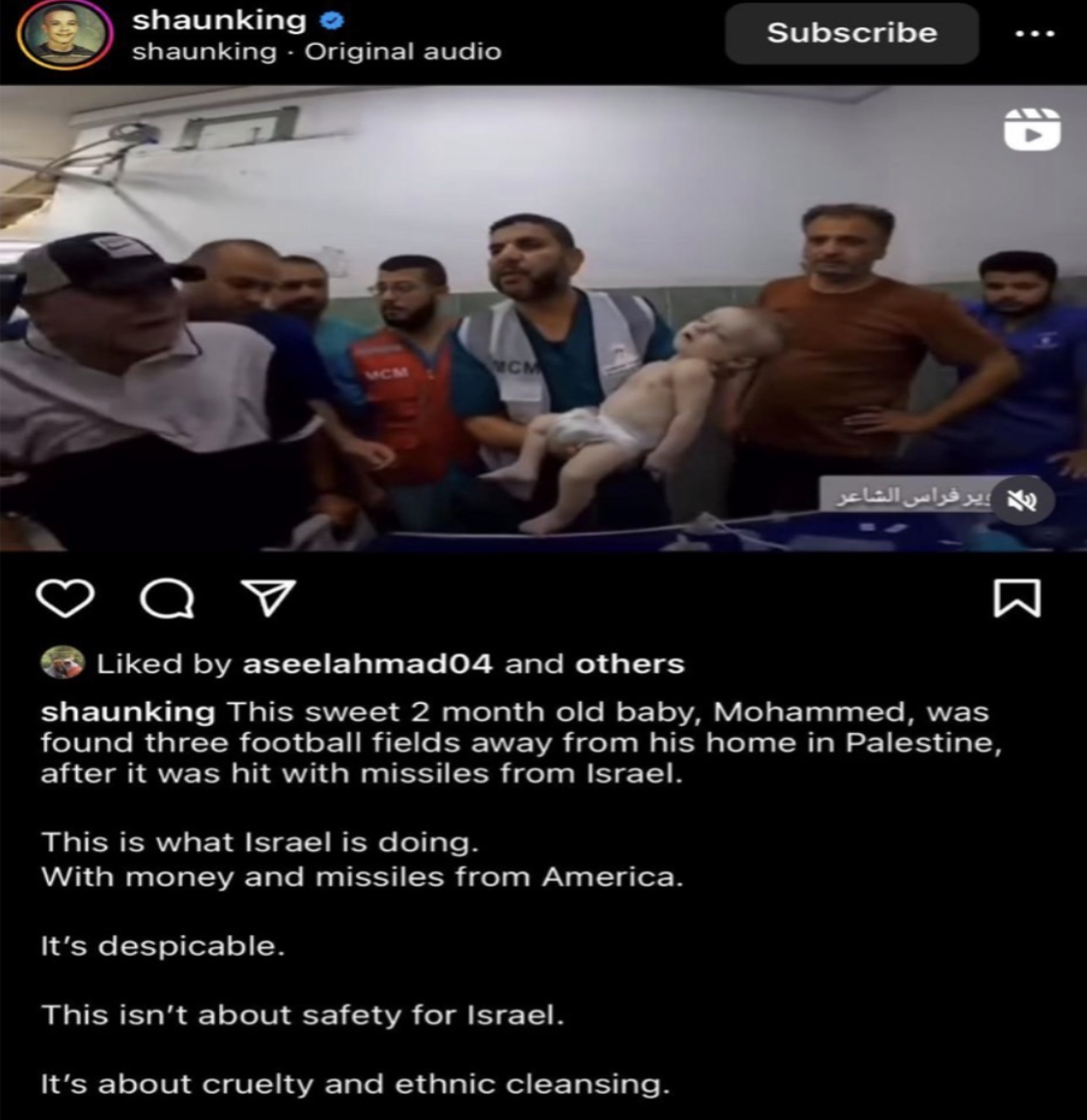
In the aftermath of October 7, 2023, Palestinian-Canadian journalist Zahraa Al-Akhrass re-posted a haunting image of a Palestinian family in mourning on her personal Instagram account. Their two-month old dead baby was reportedly found the equivalent of three football fields away from his home after it was hit by an Israeli missile. Al-Akhrass, a former video producer with Global News in Toronto, was on maternity leave at the time.

Soon after, Al-Akhrass received an email from her boss. “He said the company had received a formal complaint about my social media activity,” she tells Sandy and Nora Talk Politics, from her home in Doha, Qatar, where she now lives.

She was asked to stop sharing pro-Palestinian posts on her social media and to remove any existing posts that advocated on behalf of the people of Gaza. “They alleged that my posts violated their social media policy but they never explained why or how or which posts were a breach of company policy,” Al-Akhrass explains. “Given that I share a lot of content online I asked him to specify with direct links which content was offensive. They refused.”

She also remembers being told that her re-posts, which often contained hashtags such as #freepalestine, #gazagenocide, and #gazaunderattack, made her seem “unbalanced.”

Al-Akhrass received an email on October 13, 2023 from a Corus Entertainment workplace investigator—the parent company of Global News—who said there were concerns about the posts, and that they wanted to schedule a time to meet the following week. They informed her there would be a representative from the People and Culture department (Human Resources) in attendance and that they would arrange for her to have a union representative present.

Al-Akhrass responded to the workplace investigator with this response:

“Thank you for your email. Here’s an image of what I was looking at when I saw your email. This is one of the thousands of scenes I’ve been watching day and night for a week.” The image was of the family in mourning.

Al-Akhrass says she explained in her response that she was deeply affected by images of Palestinian suffering. She told the investigator she knew people who had died and that she had lost contact with loved ones. She felt an affinity for those suffering because of her own Palestinian heritage. She added that she was reluctant to attend a corporate meeting because she knew they would try to silence her.

She asked for a copy of the complaint. She wanted to know if the company had any requests. Did they want her to remove any and all of the pro-Palestinian comments and posts she had made? Did they want her to stop her online advocacy altogether?

Al-Akhrass had a final 30-minute phone call with Corus Entertainment’s Vice President for Editorial Standards and a senior officer from the People and Culture team who informed her of her termination. “He failed to answer my questions or provide any kind of substantial understanding of either the social media policy or my posts and how they violated the policy,” she says. “It seemed like he didn’t really know what was going on and was just asked to inform me of the decision.

At the end of the call, Al-Akhrass says she was offered a five-figure financial settlement and asked to sign an NDA  prohibiting her from publicly speaking about the termination and taking legal action against the company. “I refused to do both,” she says.

Sharing the image of the dead baby was one of the reasons cited in her termination letter for firing her.

By the time the workplace investigator finally got back to her, Al-Akhrass had already been fired. “They asked me never to share any such disturbing images with them without their consent and moved on to see which time would work to schedule a meeting.” She says it seemed strange to her that they wanted to talk after she was already fired. “It was also weird that they fired me without having a discussion about the alleged complaints against me.”

From the Nakba to the genocide

Al-Akhrass’ maternal and paternal grandfathers were born in Palestine. As children aged six and 11, they were forced to flee their country during the 1948 Palestine War, or the Nakba, the ethnic cleansing that violently displaced an estimated  750,000 to 1 million Palestinians. “The village was called Umm Al-Shagaf and about 300 people lived there,” she says.

Today, Umm Al-Shagaf is called Giv’at Nili, and it’s home to 633 Israelis. Founded in 1953 after the forced removal of Palestinian residents, it was created by Labour Zionists to be a collective agricultural centre. Today, it’s known for its wine production and tourism.

Al-Akhrass’ grandparents took refuge in Jordan, the only neighboring country to Palestine that granted Palestinian refugees citizenship, a policy mandated by an agreement with the British. “More than half of the Jordanian population today are actually ancestral Palestinian refugees,” she says.

She was born in Jordan and moved to Canada at age 22 where she studied journalism at Sheridan College.

Al-Akhrass was very proud of her job at Global News. Her team was part of the digital newsrooms and she was responsible for sharing live streams to different platforms. “We provided video content to television, YouTube and social media before the ban,” she says, referring to Meta blocking news content to avoid complying with Canada’s Online News Act, or Bill C-18.

She worked for Global News from February 2020 to October 2023. The end of her employment is forever etched into her mind: “I was nine months postpartum and was suffering from postpartum depression,” she says. “The day I found out that I had been terminated I was going through a health crisis.”

She took to Instagram to announce the dismissal: “I was fired on October 17 for posting about Palestine on my social media,” she said in the video. “This is not about me but about us Palestinians. I feel disappointed that this organization has failed me as a Palestinian, racialized journalist.” The post has gotten over 3 million views.

A grievance in arbitration

Al-Akhrass is pursuing action against Global News for wrongful dismissal—a legal challenge that could set a precedent regarding free speech, employee rights, and the obligations media organizations have towards their staff. “The grievance process has escalated to arbitration,” she says. “There’s a lot of waiting and we’re currently waiting for a hearing date.”

In Canada, unionized employees cannot sue in regular civil courts for dismissal. The grievance and arbitration process is the mandatory legal equivalent, and carries the same binding weight as suing in civil court. The arbitrator’s ruling will be final and legally binding on both the union and the company. “If they rule in my favour, the company is legally forced to comply with the remedy, which is reinstatement or financial compensation. It would be extremely difficult for the company to appeal the decision,” explains Al-Akhrass.

The Unifor grievance letter states her union’s position that Al-Akhrass was fired without just cause, alleging that Global Television did not act “ in a fair, reasonable, and unbiased manner” and did not properly consider her rights.

Sandy and Nora Talk Politics reached out to Unifor about Al-Akhrass’ case and received this statement from Jenny Yuen, a communications representative: “There is an outstanding grievance, and we are working through the procedure with our member. Out of respect for the process, it would be inappropriate to comment further at this time.

After she went public with her story, Al-Akhrass was unable to find alternative employment in Canada’s media sector, so in late 2025, she moved to Doha, where she currently works as an independent journalist with several outlets. “I hoped that working in regional media in the Middle East would be the best option for me after everything that happened,” she says.  “I’m a member of the International Press Institute in Vienna which facilitates my attending forums like the Doha Forum and other political and media events in the Middle East.” Al-Akhrass also had another baby this past August.

The termination has made her employment possibilities so much harder. “The moment you Google my name it shows that I was fired from my job,” she says. “This whole thing with Global News has become the defining point of my career.”

Al-Akhrass hopes her experience will help to win justice for every silenced Palestinian voice in the Western media landscape. “This fight is really not for me personally,” she asserts. “If it was, I would have signed the NDA, taken the money, and walked away tens of thousands of dollars richer than I was.”

Episode 399 – Tech fascists vs. Data sovereignty

In this week episode, Sandy and Nora talk about data sovereignty and how tech fascism is challenging national power.

Episode 398 – Global Election Circus

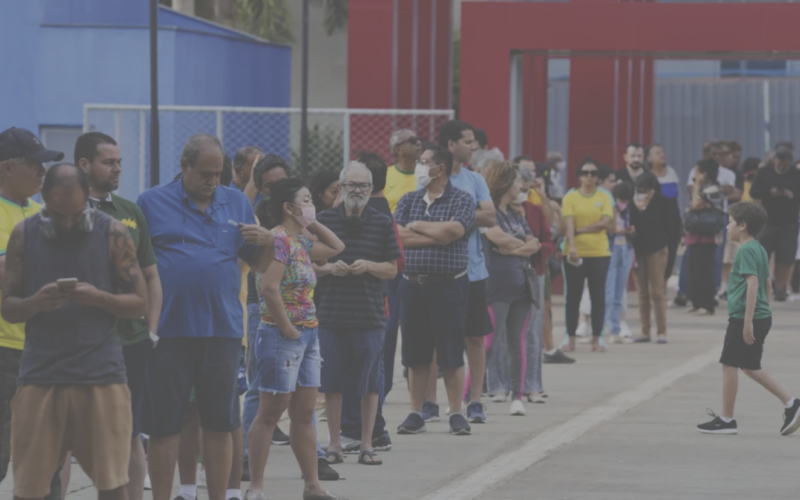
From BC to Ottawa, Toronto to Brazil, the United States to Israel, Sandy and Nora talk about elections, and what the left can learn from the right’s victories and failures this past week.

Episode 397 – What happened at CFB Wainwright?

When fire ripped through a training ground at CFB Wainwright, Canadians were told that there was a mass casualty incident. Since, the government has announced four deaths, despite earlier media reports saying seven. Sandy and Nora talk about how little information is getting out, and how the government is both ultimately responsible for what happened there and the sole conduit through which information is being released. Plus they talk about Opera Calgary, the Vancouver election and Alberta’s racist referendum.

Tickets to Hamilton’s live show on Nov. 13, 2026 are available here.

Episode 396 – The Conservative Youth Movement

In this episode, Sandy and Nora talk about how the Conservative Party has finally cracked the youth code, and why the centre and left have abandoned young people in their promises and rhetoric.

Episode 395 – Canada hopes you don’t notice Spain and France right now

In this episode, Sandy and Nora talk about the protests in France and Spain, why you’ve heard so little about them from Canadian media and why King Charles will always lead the news at the CBC.

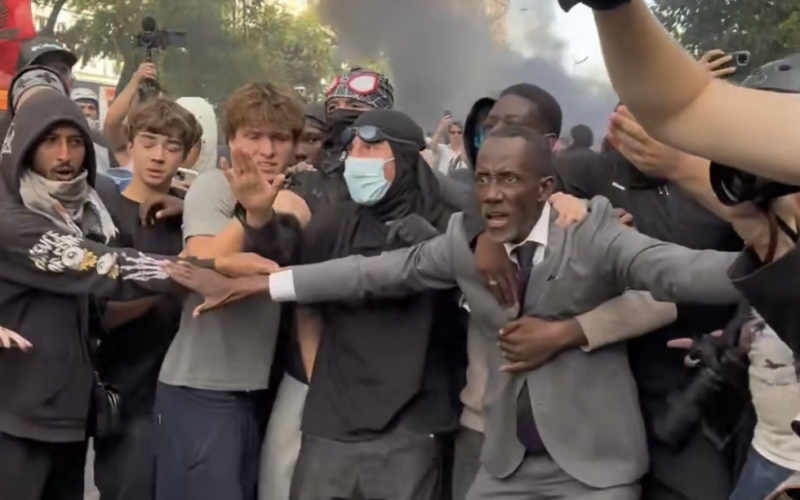
Image is of mayor Bally Bagayoko, of St. Denis, protecting youth against the riot cops 

Episode 394 – Critizing Israel is illegal now?

In this episode, Sandy and Nora talk about how Canada’s Zionist elites are trying to pin antisemitic violence on Palestinian solidarity, while the far right is fed by anti-solidarity public policies. Plus we talk Quebec election and speed cameras.

Episode 393 – The 1500-person summit you didn’t hear about

In this episode, Sandy and Nora talk about the Summit of Black Canadians and how media ignored it, the left seemingly didn’t realize it was a thing and the Liberals expertly used it to organize.

Episode 392 – Fire Sale! All Canadian Assets Must Go!

In this episode, Sandy and Nora talk about Mark Carney’s investment conference, and how he’s fulfilling the prophesy set out in the 1995 Martin-Chrétien budget.

WINNIPEG SHOW TICKETS HERE.

It is happening right after this event — the noble and Whimsical Clothing Swap.

COME TO BOTH.

Episode 391 – The Left’s white supremacy problem

In this episode, Sandy and Nora talk about how pervasive white supremacy permeates Canadians leftist spaces, and what must be done to try to weed it out, if the left has any hope of success.

Episode 390 – The Liberals steamroller on

After three sleepy summer federal byelections, there are no signs of cracks in the Carney consensus. How should progressives read these results? Plus we talk about Canada’s dismal help for Nepal.

Episode 389 – Quebec, Canada’s bulwark against US invasion

In this episode, Sandy and Nora talk about Canada’s trade war with the United States and how Quebec has an outsized influence over how Canada reacts.

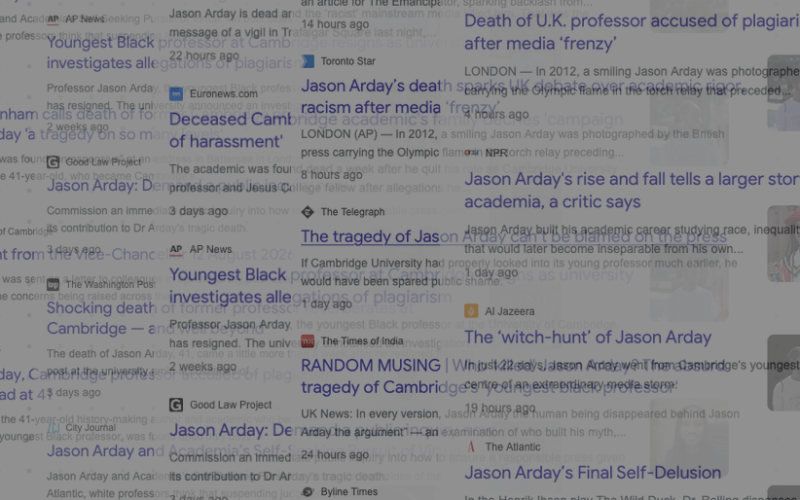
Episode 388 – Dissecting the public murder of Dr. Jason Arday

In this episode, Sandy and Nora talk about the death of Dr. Jason Arday, and how mainstream media took a story from the far right and turned it into a harassment campaign against the now-deceased Cambridge professor.

Episode 387 – Laundering Palestinian Solidarity into a hate crime

In this episode, Sandy and Nora talk about the recent study into antisemitism on campus in Canada and look at how the authors have intentionally tried to turn solidarity with Gaza and opposition to Israeli war crimes into a hate crime.


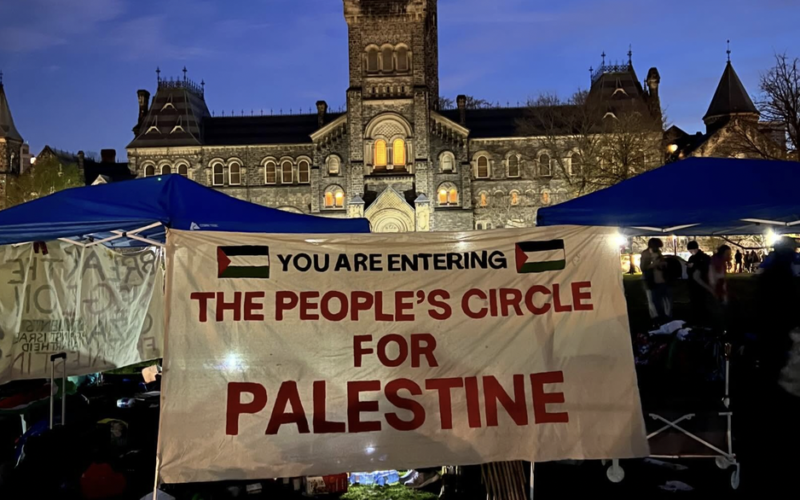
Photo is from the Palestinian Youth Movement – Toronto

Episode 386 – Liberal con Carney

In this episode, Sandy and Nora talk about Carney the Conservative, and how the Conservatives are drawing on international far-right tactics to try and eke out a space for them. Plus, media is complicit and the NDP floats around in the ether.

Episode 385 – Elbows so far down that Agnico Eagle Mines is trying to get rights to mine for them

In this episode, Sandy and Nora talk about Carney’s consistent capitulation to the United States, including sending representatives to the latest attack on leftwing activists.

Episode 384 – Saving creativity and authenticity from AI death

In this episode, Sandy and Nora talk about what happens when everyone starts to all sound like ChatGPT, and how alienation from what is real and authentic will drive everyone over the edge.

Episode 383 – SLAPPing Free Speech

In this episode, Nora talks with Luke Lebrun, editor in chief of Press Progress, about SLAPP lawsuits and free speech in Canada.

Episode 382 – Carney’s Senate Snooker

In this episode, Sandy and Nora talk about Mark Carney’s new senate appointees. Plus, why are progressives calling for more surveillance tech?

Episode 381 – No Canada without Canadian culture

In this episode, Sandy and Nora talk about Canadian culture and sport, and how governments have consistently defunded that which makes Canada, Canadian.

Episode 380 – Another incel attack

In this episode, Sandy and Nora talk about the shooting attack of incel Seth Hatfield. Plus, Carney promises to bail out developers and calls it housing relief.